

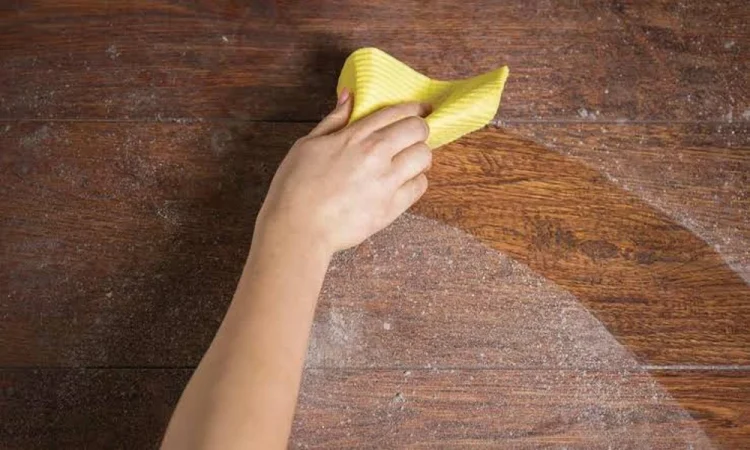

An air cleaner does not replace cleaning dust that has settled on shelves, furnishings and other surfaces. Its job concerns air passing through the equipment. For an ordinary household clean, treat the existing deposits and the airborne particles as related but distinct parts of the work, with a suitable method for each.
This distinction becomes visible in a room full of belongings. A resident may run a filter for days and still find dust on the top of a bookcase. That does not prove the machine captured nothing; the bookcase deposit was never a direct measure of filtration performance. It also does not remove the need to clean the bookcase appropriately.
A surface deposit is already outside the airstream
Look at the room as a collection of surfaces as well as a volume of air. Open shelving, display pieces and the backs of accessible furnishings can all require their own care. A portable unit cannot be expected to perform the physical cleaning of those objects merely because they share a room with its intake.
The practical implication is to choose an appropriate cleaning method for each material. A robust painted shelf, an unfinished wooden object and an electronic device may have different care instructions. Do not turn a general suggestion to reduce dust into permission to wet every surface. The object’s requirements still govern the method.
Some belongings are awkward to clean safely or are valuable enough to need specialist advice. That does not make a room filter their substitute cleaner. It means the surface task remains separate and may need help. Acknowledging an untreated item is more accurate than assuming that running equipment nearby has dealt with it.
For a manageable household project, start with accessible areas that can be cleaned according to their care instructions. There is no need to empty every cupboard at once or disturb inaccessible cavities. The scope should be a practical ordinary clean, with appropriate support for areas that cannot safely be reached.
Disturbing the dust changes where it goes
The EPA’s guidance on indoor particulate matter explains that activities such as walking, sweeping and dusting can stir settled dust into the air. It notes that damp dusting can help limit this return to the air. Apply that principle only where the surface’s care directions allow the method.
Deliberately blowing deposits off a shelf toward an air cleaner is not a sensible substitute for suitable surface cleaning. It moves the material around while assuming the equipment will capture what has been disturbed. The goal of household cleaning is to remove the deposit by an appropriate method, not create a visible cloud to demonstrate that a machine is working.
A vacuum also needs to suit the surface and the task. Use its intended attachments and maintain it as instructed. Equipment chosen for ordinary household dust should not be pressed into service for unidentified building debris or material from a hazardous incident. The resemblance of two dusty surfaces does not establish that they can be treated alike.
If dust is associated with suspected asbestos, lead, mould or other hazardous material, stop treating the situation as routine housekeeping. Obtain the relevant assessment and professional response. This is a different scope from cleaning ordinary accumulated household dust, and a rental air cleaner does not make uncontrolled disturbance appropriate.
Choose filtration for the airborne part of the problem
Once the surface-cleaning task is understood, consider whether temporary air cleaning has an appropriate role. For a resident exploring temporary air filtration in Richmond Hill, describe the activity and the room when discussing equipment. Ask what the proposed model and supplied filters are intended to address.
A machine’s purpose should remain specific. It may be considered for airborne particles while the room receives suitable cleaning; it should not be described as cleaning all the contents. That difference matters when deciding what work the household will still perform and what result can honestly be expected from the equipment.
Follow the provider’s and manufacturer’s operating directions, including placement and any required filter care. Do not tuck the unit inside a crowded display arrangement simply to hide it. Nor should dusty objects be placed against an intake as though it were a vacuum nozzle. The machine needs to be used for its designed function.
Health-related concerns deserve their own advice. A cleaner-looking room or a running filter does not guarantee relief of symptoms, and household observations cannot establish a medical result. Where symptoms or particular vulnerabilities influence the decision, discuss them with an appropriate health professional rather than asking the rental to serve as a treatment promise.
Read the shelf and the filter as different observations
After cleaning, a shelf can show whether that surface has been maintained, but it cannot certify the quality of all the room air. Similarly, the appearance of a filter does not measure how thoroughly the furniture was cleaned. Each observation relates to a different part of the process and has its own limits.
A modest return of ordinary dust over time does not automatically mean the cleaning failed. Consider the room’s continuing use and the maintenance it receives. The useful response may be a more practical surface-care routine, rather than repeatedly ordering additional filtration in the hope that future dust will cease entirely.
Fewer difficult-to-reach display items or easier access behind frequently cleaned furniture may make that routine more sustainable. These are choices about how the room is lived in, not technical air-quality claims. Make changes that fit the household rather than treating minimal decoration as a universal requirement.
A successful clean leaves the room easier to care for and its remaining tasks easier to understand. Give settled dust an appropriate surface treatment and filtration a defined airborne role. That division produces a more honest expectation than asking one box in the corner to maintain every shelf, fabric and object in the room.